Endless Pools Inc. Swimming Machines
Questions? Call 1 (800) 732-8660
Site Map
Click here to Request Your Free DVD Today!
  About Endless Pools Endless Pools Products Swimming Water Exercise Aquatic Exercise Relaxation & Fun Triathlon Training
 

Endless Possibilities (reprinted from Triathlete Magazine)

By Jay Prasuhn
April 2002

Bookmark This Page  |  Send To A Friend

Swim training in an Endless Pool
Based on your body's response to the water current, an Endless Pool actually allows you to feel when you are swimming with proper form. When your form begins to fall apart, your body will feel increased drag.

Tired of flip turns, lane waits and random lap swim schedules? An Endless Pool could be your answer; making you a more efficient–and faster– swimmer in the process.

The lake is just thawing, the local pool is a 20-minute drive away, and even at that, you’re not too jazzed about having to work your schedule around the time of Masters swims. Your focus spring race is creeping up, and your stroke reminds you of a recent show you watched on Animal Planet–not the one about sharks cruising the ocean’s depths but the episode that showed the wildebeest crossing a river.

The answer may be a “treadmill” style stationary pool, where a steady flow of water allows you to swim in place. And Endless Pools has a stationary pool that can help to get you out of the water first–or at least in the lead pack–in the summer.

We weren't sure of how realistic the workout claims were from the folks at Endless Pools, so they set up a swim at a local San Diego pool owner’s home. Turns out the unit is a great way to do self analysis on efficiently pulling yourself through the water.

Endless Pools has been around since 1988, but given the cost of these units–from $17,000 to $35,000–not too many triathletes have experienced this unique training pool. Have you ever watched your swim stroke change–while swimming? Now you can.

It wasn't until Endless Pools shipped demo units to Ironman Florida, USA in Lake Placid and the world championship in Kona that many from the triathlon community saw them in action for the first time, as age groupers churned away at what seemed as difficult as any pool or open water practice. Then we tested a unit and turned some laps (a term used loosely) of our own, and we became convinced that form and body position adjustments, all done in real-time, could actually surpass training with more conventional methods.

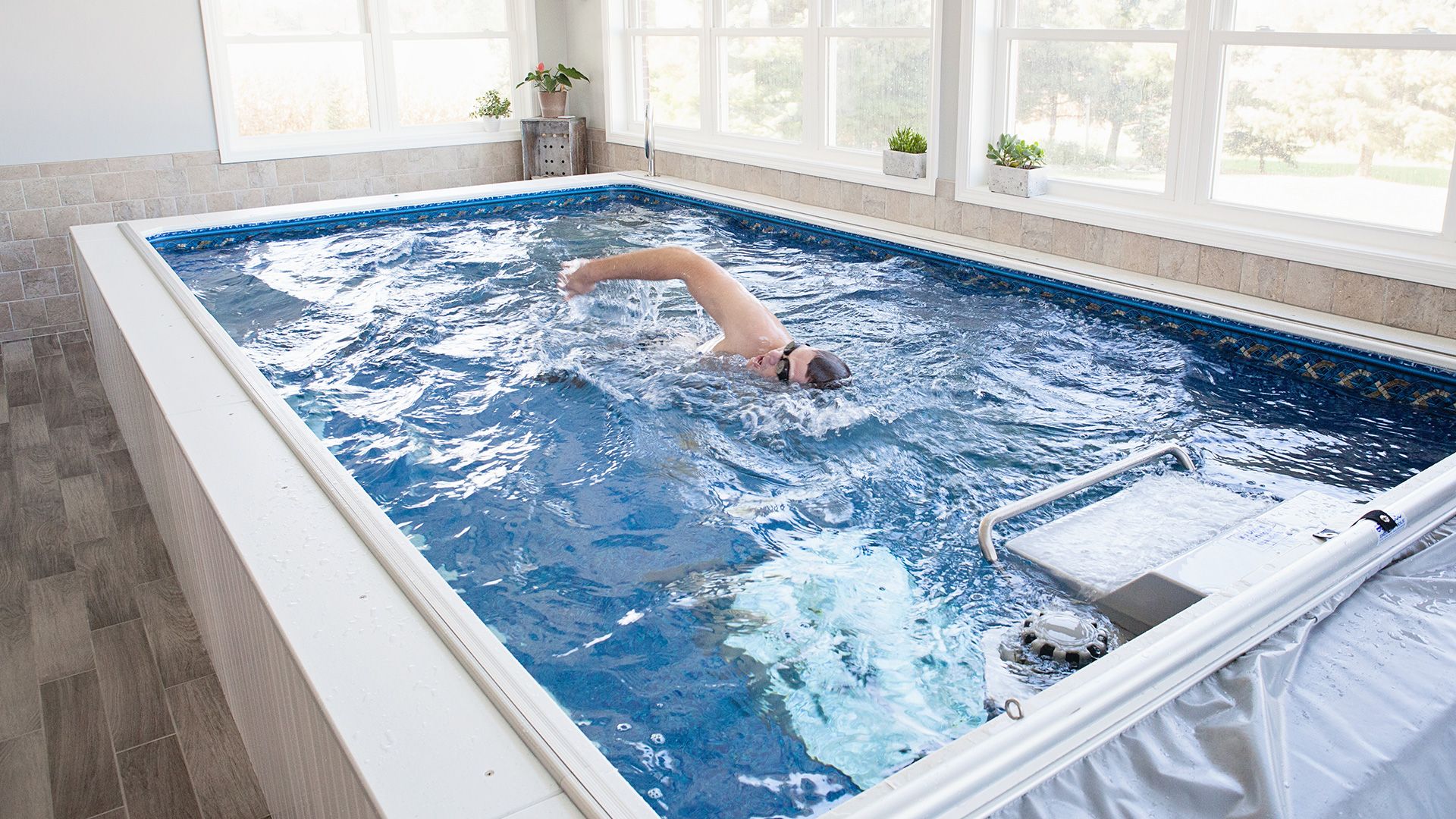
Early incarnations of treadmill swimming were conducted in narrow swimming flumes. It’s unfair to call this pool a flume, as there’s much more arm stroke freedom than a flume would allow. The 8-foot by 15-foot units don’t demand much more space than a traditional Jacuzzi would, and they can be built indoors in a sunroom or outdoors on a deck, and above ground or in-ground. Veteran pro triathlete Ken Glah has one in his basement in West Chester, Pa., while ITU swim specialist Sheila Taormina has one in her home in Livonia, Mich.

The 8-foot by 15-foot units don’t demand much more space than a traditional Jacuzzi would, and they can be built indoors in a sunroom or outdoors on a deck, and above ground or in-ground. Veteran pro triathlete Ken Glah has one in his basement in West Chester, Pa., while ITU swim specialist Sheila Taormina has one in her home in Livonia, Mich.

Check out Sheila's Strokes Workout

The pools are made of sturdy galvanized steel with a vinyl interior liner. A 16-inch propeller powered by a hydraulic motor pumps a river-like current down the center of the pool. The water is then drawn at the back of the pool into an underwater grill, and moved along the pool sides to the front, creating a circle of recycled water that flows in terms of pounds per square inch, up to 1,500 psi—a flow equivalent to a 100-meter sprint effort.

We visited San Diego Endless Pools owner John Goode to see just how a swimming treadmill works. The 68-year-old contractor, a Masters swimmer and former triathlete, finds technique improvement and the ability to adjust it on the fly the biggest benefit of his product. We swam in his pool overlooking Mission Bay, and position was the first thing we noticed; as soon as you pick up your head even a little bit, you feel yourself being pulled to the back of the pool. It’s the kind of tangible feedback that physically tells you how disruptive poor body position or stroke can be to your efficiency. “With the position of your head, hands and hips, you can tell the difference in your drag, and adjust it accordingly,” Goode says. “You start to develop a tactile sense of what is a smooth stroke and position. If you have a lopsided stroke you instantly find out, adjust and balance it.”

"The answer may be a 'treadmill' style stationary pool... Endless Pools has a stationary pool that can help to get you out of the water first—or at least in the lead pack..."

You can watch your progress day to day by using a tool like the Speedo stroke counter, which counts your stroke at a given water flow. As your efficiency goes up, your stroke count goes down. A coach standing poolside can also point out correctable techniques while you’re stroking. Noted swim coach Steve Tarpinian uses the pools as part of his coaching program and has a video camera mounted underwater to record the athlete’s stroke for future review. A great way to further improve is to watch two tapes: yours and a pro’s. It gives you a chance to analyze stroke and body position and roll differences.

But some could be self-coached. An optional mirror mounted below and in front of you gives you instant feedback to your position. An inefficient water catch, head position, reach or body roll can all be seen underwater, while you swim.

So how do you measure your effort? Likely you’re used to measuring your efforts traditionally, by doing 100s on a time-based rest interval. That form of measurement is incongruous in a swim treadmill–but can still be closely replicated. In the pool, there is no wall to measure distance, just perceived effort against your selected flow speed, in this case, maybe 650 psi. It’s easy to adjust your effort if you go out too hard in the first 25 meters of a pool swim; you just slow down. In the Endless Pool, however, you’re forced to maintain your speed–and you'll pay with a harder effort. Someone wishing to do intervals could simply go at their average 100 time, move out of the flow, take their breath and go again on the 1:35. If you want to take an interval break, just stop swimming, go upright and pull off to the side from the main flow.

There’s nothing that inhibits you from your traditional pool workouts. “I can do kicking, pulling, all the things I do in a lap pool,” Taormina says. Kick drills can be done with a board against the current, or with the jet off, you can grab the bar at the unit’s front and kick away. Want to do some backstroke, catch-up drills, or 15 minutes of warm-up/cool-down freestyle? Dial the flow down to your tempo.

Training benefits aside, the benefit to a 50-hour-a-week business person is obvious: convenience and time efficiency. “I don’t ever have to drive or worry about pool hours, or whether I can get a lane, or whether the pool temperature is what I like,” Goode says. “And I don’t have to go around my work schedule; I swim when it’s convenient for me, not when the Masters swim is going on.” Also gone are lane fees, seasonal swim planning, and as Taormina points out, “the smelly wet bags and wetsuits in the back of the car.”

Of equal importance is its us as a rehab agent. The pool is available in differing depths of up to six feet, and optimal depth for water running with the motor shut off to rehab injuries. Also, an intake jet at the machine’s front sends a jet of water that can be used to massage your lats following a tough pull buoy workout.

If you’re looking for a convenient workout, but can’t build a pool in your tiny third-floor apartment, there’s a great land-based alternative: the Vasa Trainer. The workout bench, raised at one end, features pulleys that see “stroke” resistance provided by your own body weight. It really is challenging, and makes for a great anytime swim workout at home. And the mechanics of its design makes it impossible to have poor technique with the Vasa Trainer; it’s physically impossible to “swim” without a raised elbow, so a proper stroke in reinforced. At a price of $700 to $1,200 depending on added accessories, it’s certainly a more cost-effective option.

Check out the Endless Pools web site at www.endlesspools.com or visit Vasa Trainer online at www.vasatrainer.com.