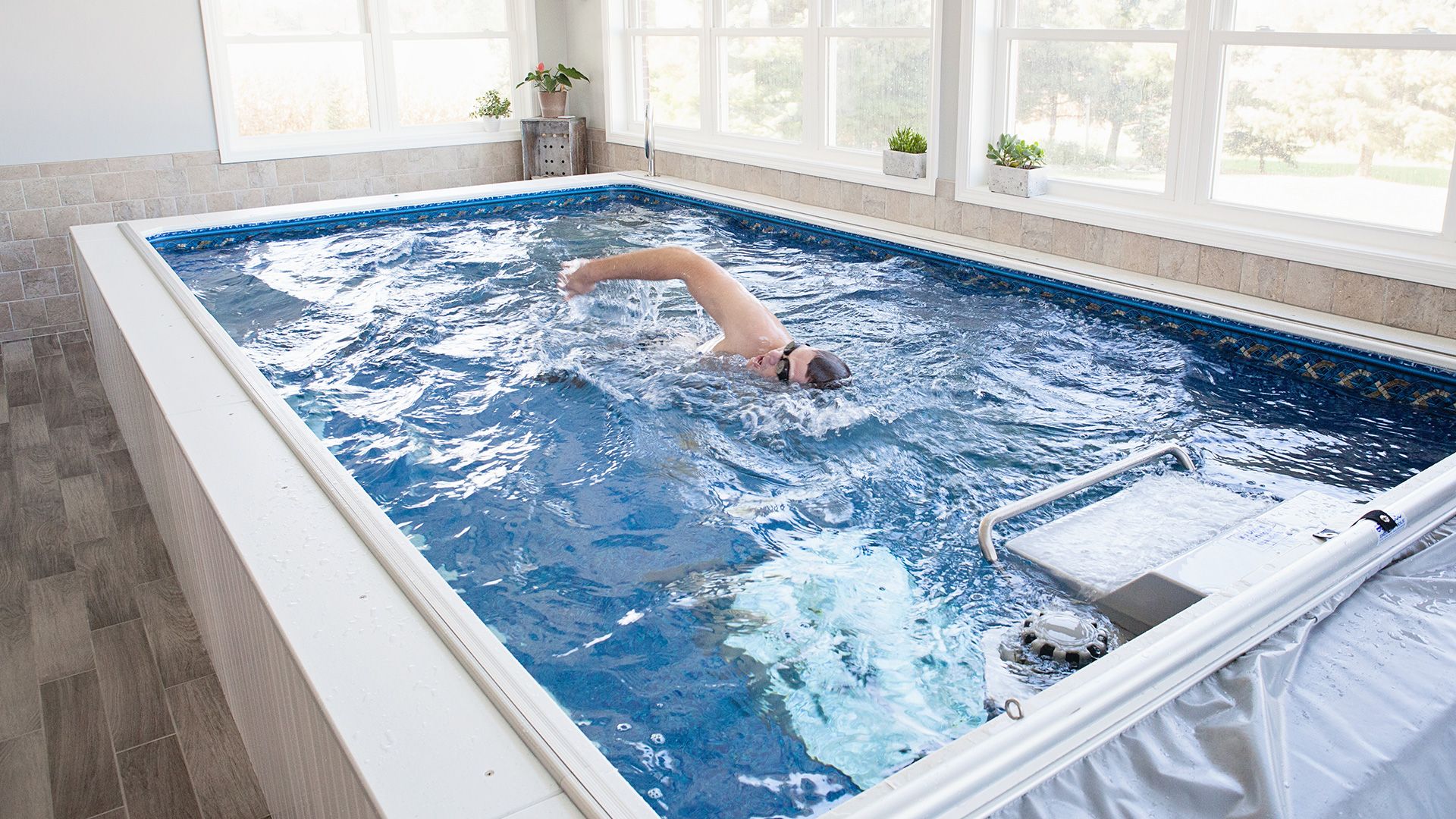
By eliminating turns flip, you can build true open water endurance.
Swim training with the Endless™ Pools Hydrodrive™ current is like swimming in open water – no turns, no shared lanes, no stopping.
The water flow is wider than your body and deeper than your stroke creating a smooth, comfortable, river-like current to swim against. With your own convenient pool, train as long as you want, on your schedule. What's more, your Endless Pools training gives you the resources to do an entire triathlon in your neighborhood – even practice transitions at home!
How Professional & Age-Group Triathletes Get Out of the Water Faster

/f/76838/443x271/e7efa7b0bf/video-brownlee-training-gallery.jpg "Jonny and Alistair Brownlee at their training pool")
/f/76838/443x271/10e0673c6d/video-luke-mckenzie-gallery.jpg "Professional Triathlete Luke McKenzie")
/f/76838/443x271/9f38dbdd41/video-pete-jacobs-gallery.jpg "Professional Triathlete Pete Jacobs crossing the finish line at the IRONMAN World Championship")
/f/76838/443x271/965c832d58/video-steve-walker-gallery.jpg "Steve Walker crossing the IRONMAN World Championship finish line")
/f/76838/443x271/d6c0ae6af0/video-derek-fitzgerald-gallery.jpg "IRONMAN triathlete Derek Fitzgerald")
/f/76838/443x271/931fafad49/video-carol-blattspieler-gallery.jpg "IRONMAN triathlete Carol Blattspieler swimming in an Endless Pool")
/f/76838/576x500/d92877238e/alistair-hero.jpg "Olympic Gold Medalist Alistair Brownlee")
"As soon as I started using the Endless Pool, my Achilles stopped getting stiff. That was a massive, benefit. The pool made a huge difference."
Alistair Brownlee, 2X Gold Medalist
Maximize the potential of your pool.
Seeing the benefits that Endless Pools training provides, many of the leading triathlon stores and coaches have installed our pools to provide their clients with the best possible tools to improve their swim technique.
Add an underwater treadmill and reduce the wear and tear on your joints. It's perfect for muscle recovery, injury rehab and fitness development. Regular Endless Pools training will help you achieve a new PB – we guarantee it!
/f/76838/1244x1080/b7529d5603/inspiration-treadmill-tile.jpg "Running on an Underwater Treadmill")
/f/76838/576x500/583e9c7e9e/triathlete-hero.jpg "Triathlete training at home in his Endless Pool")
"The pool is paying great dividends in time shaved off my swim... I qualified to race in the world championship in Kona."
Eddie H., Castle Rock, CO
Success Story
Lionel Sanders Windsor, ON
"My first triathlon back in 2010, I was almost last place out of the water," recalls professional triathlete Lionel Sanders. A self-described "weak swimmer," he installed an Endless Pools in his basement. With the pool's mirrors, he could identify and fix his technique. The result: At the Kona world championships that same year, he exited the water exactly 3 minutes faster than his previous best.
I'd been crossing the centerline. I've been able to correct that. Every single day I do a technical session, I can see clearly if I'm improving.
